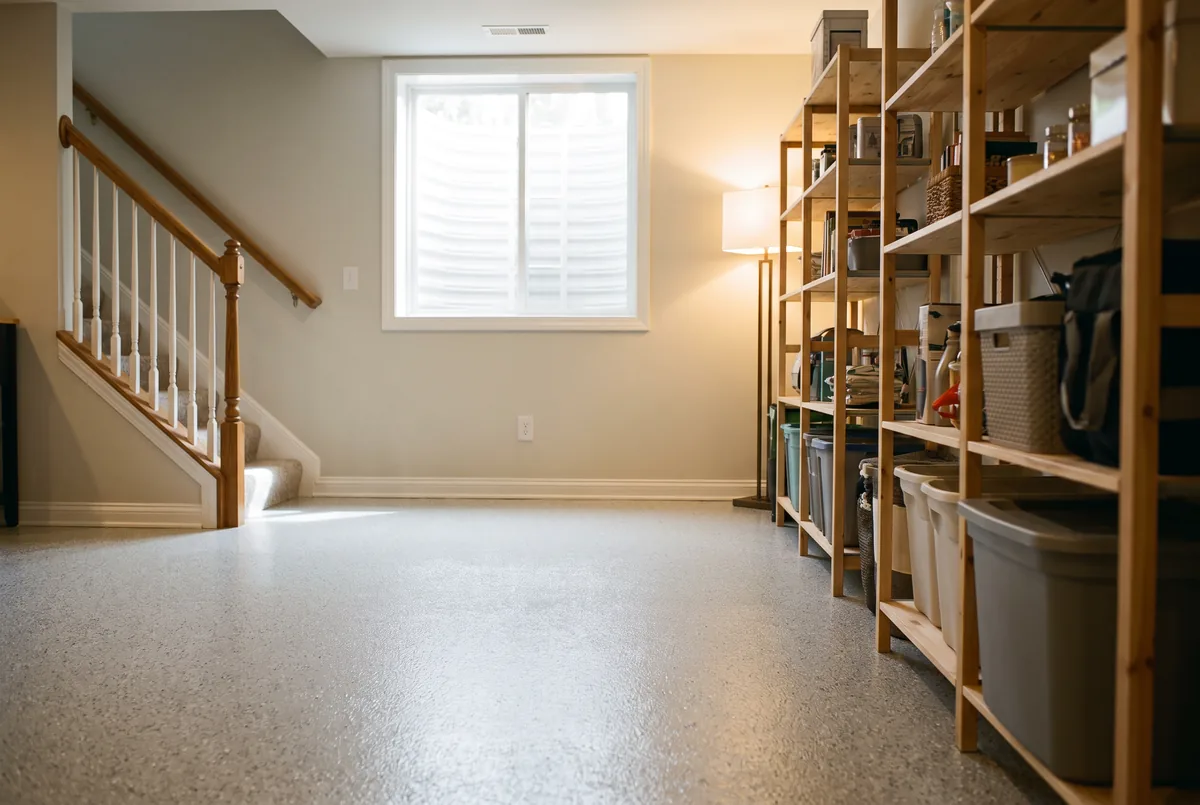
Seal out moisture, eliminate concrete dust, and transform an unfinished basement into a clean, usable space.
Call for a Free EstimateBasement floor epoxy in Carmel is less common than garage coatings, but the results are arguably more dramatic. An unfinished Indiana basement is usually dark, damp-feeling, and covered in porous concrete that sheds fine gray dust onto everything you store on it. After epoxy coating, the same space feels dry, clean, and finished—bright enough to be an actual room rather than a utility storage area.
The critical difference between coating a garage floor and a basement floor is moisture. Indiana basements sit directly in contact with soil that holds water year-round, and moisture vapor migrates through concrete constantly. We test every basement slab before quoting, because the moisture situation determines whether standard epoxy, a moisture-blocking primer, or a full moisture mitigation system is required.
The installation sequence for a basement floor is similar to garage work, with extra attention to moisture at every stage. We start with a calcium chloride moisture test left on the slab for 60–72 hours, which gives us a precise vapor emission rate in pounds per 1,000 sq ft per 24 hours. Different epoxy systems have different MVE tolerances—knowing the number lets us spec the right primer rather than guessing.
After moisture assessment, we diamond-grind the surface. Basement concrete in Carmel’s newer subdivisions is often relatively smooth from the pour and doesn’t have the same traffic damage as a garage slab, but grinding is still required to create the mechanical bond the epoxy needs. Any cracks are filled with semi-rigid filler.
If moisture readings are above threshold, we apply a two-component moisture-mitigation epoxy primer before the decorative layers. This primer blocks vapor movement from below without requiring you to inject the perimeter or install a sump. It’s not a waterproofing solution for active water intrusion—but for passive vapor, it works well and is significantly less expensive than a full waterproofing system.
The decorative base coat and optional flake broadcast go on after the primer cures, followed by the topcoat. Most Carmel basement jobs take 2 days on site plus a week of cure before you can put heavy furniture or storage back on the floor.
If you’re converting an unfinished basement into a gym, playroom, hobby space, or home office annex, an epoxy floor is one of the most cost-effective ways to make the concrete feel finished. It’s significantly cheaper than tile or LVP flooring over concrete and holds up better in spaces with moderate moisture.
Bare concrete in Hamilton County basements sheds fine dust continuously. It coats storage boxes, HVAC filters, and anything stored on the floor. Epoxy seals the surface completely and eliminates this problem. If your basement HVAC system seems to need constant filter changes, the concrete floor is likely a contributing factor.
Laundry rooms, mechanical rooms, and storage basements all benefit from a floor that has grip and is easy to mop. A flake epoxy system with a textured topcoat provides grip even when wet—important in a utility space where water from a washing machine overflow or water heater drip can make bare concrete very slippery.
Indiana sits in the Midwest’s humid continental climate zone, which creates specific challenges for basement slabs that aren’t present in drier climates like Colorado or Arizona.
The soil in Hamilton County is predominantly clay loam—a dense, low-permeability soil type that holds water for extended periods after rain. This means the soil surrounding and below most Carmel basement slabs is consistently moist, pushing vapor upward through the concrete continuously. Unlike sandy soils that drain quickly, clay releases that moisture slowly over weeks and months.
Indiana summers add humidity from above. On warm, humid July days, the basement floor is often cooler than the dew point of the incoming air, causing condensation to form on the surface. This isn’t a leak—it’s atmospheric moisture—but it can make the floor feel damp and create conditions that allow mold to grow if there’s organic material in contact with the floor.
Epoxy coating addresses both of these mechanisms. It seals the concrete so vapor can’t evaporate from the surface, and it creates a non-porous surface where condensation can’t soak in. Most Carmel homeowners notice a measurable difference in basement humidity levels after coating, because the concrete is no longer acting as a passive vapor emitter.
Basement floor epoxy typically runs $3.50–$6 per square foot installed, with the moisture situation being the biggest cost variable.
Moisture mitigation primer. Standard epoxy primer works for slabs with MVE under about 3 lbs/1,000 sq ft/24 hrs. Above that, we use a two-component moisture-blocking primer that costs more per square foot and requires additional cure time. Roughly 40–60% of Indiana basement slabs we test need this, which adds $0.75–$1.50 per sq ft to the job.
Square footage and layout. A simple rectangular open basement is faster to grind and coat than a space with multiple rooms, columns, low clearances, or built-in utility areas. We measure carefully during the estimate visit because layout affects total labor time significantly.
Active water issues. If there’s active water intrusion from wall cracks or through the floor joint, epoxy alone won’t solve it. We’ll flag this during the estimate and can refer you to a waterproofing contractor before we return to coat.
| Scenario | Estimated Cost |
|---|---|
| 600 sq ft basement, standard moisture, flake system | $2,100–$3,200 |
| 800 sq ft basement, elevated moisture + mitigation primer | $3,200–$4,800 |
| 1,000+ sq ft, multiple areas, standard moisture | $3,500–$5,500 |
Epoxy vs. LVP (luxury vinyl plank). LVP over concrete is popular and looks great, but it requires the concrete to be reasonably flat (no more than 3/16“ variance over 10’) and creates a floating floor that can shift or buckle if moisture gets underneath it. In Indiana basements with moderate vapor, LVP also risks trapping moisture below the planks, which leads to mold. Epoxy bonds directly to the concrete and doesn’t trap moisture anywhere.
Epoxy vs. tile. Tile over concrete is durable and looks good, but installation is expensive, grout lines collect dirt, and removing tile later is a significant job. Epoxy is faster to install, seamless, and easier to clean long-term. For utility spaces, it’s almost always the better value.
Epoxy vs. paint. Concrete floor paint is not the same as epoxy. Paint sits on top of the surface without bonding chemically to the concrete. It peels. Epoxy penetrates the surface and forms a chemical bond that can’t be separated from the concrete without grinding. If your basement has a painted floor that’s peeling, that paint needs to come off completely before any coating can go down.
It depends on the moisture vapor emission rate, not just whether the floor looks wet. We test every basement slab before starting. If vapor emission is elevated—which is common in Hamilton County due to clay soil and Indiana’s water table—we use a moisture-mitigation primer that blocks vapor before applying the epoxy system. A floor that looks dry can still fail without this test.
Most Carmel basement floor jobs run between $2,000 and $4,500 depending on square footage, system type, and the moisture situation. A typical unfinished Indiana basement of 700–900 sq ft runs about $2,500–$3,800 for a full-flake epoxy system including moisture testing and primer.
Epoxy seals the concrete, which eliminates concrete dust and reduces the surface area from which soil moisture evaporates into the air. This typically reduces musty odor significantly. However, if the source of the smell is active water intrusion through walls or floor cracks, epoxy alone won’t solve it. We’ll flag active water issues during the estimate visit.
Free on-site estimate includes a moisture test. No obligation, no pressure. Serving all of Hamilton County.
Call (317) 493-0591 Request a Quote Online